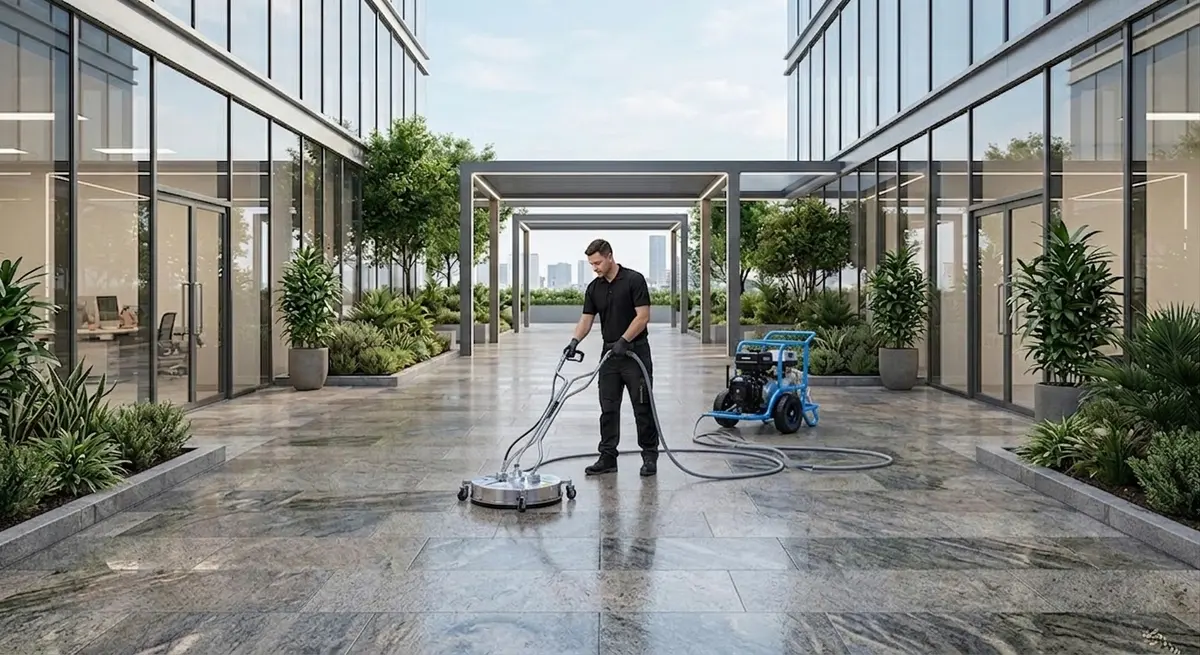
High-Pressure Cleaning
High-Pressure Cleaning in Perth
High-pressure cleaning for concrete, car parks, paths, loading bays and building surrounds — practical surface cleaning we can service safely.
- $20M public liability insured
- Police-checked crews
- WA owned & operated
OVERVIEW
Who it's for
Commercial pressure cleaning in Perth covers a wider range of surfaces than most quotes acknowledge: unsealed concrete hardstand and driveways, exposed aggregate and liquid limestone paving, brick and rendered masonry, Colorbond fencing and roofing, and the loading bays, car parks and building frontages that sit in front of all of them. Each of those surfaces behaves differently under a pressure washer, and treating them all the same way is the most common cause of a disappointing — or damaging — result.
We clean hardstand, car parks, entries, loading bays and warehouse exteriors for facility managers, strata managers and builders across Perth metro. Before we quote, we confirm which surfaces on your site are safely serviceable and which need a gentler method, because a result that lasts is worth more than a result that looks good for a week and strips a render coating in the process.
Two things set this apart from most Perth pressure cleaning listings. First, we explain the method — why flow rate matters as much as pressure, when a soft wash is the right call instead of a high-pressure clean, and why limestone and exposed aggregate need a different approach to plain concrete. Second, we treat washwater as something that has to go somewhere: trade waste rules, stormwater separation and where the runoff ends up are part of how the job is planned, not an afterthought.
Facility managers, strata managers and businesses needing hardstand and exterior cleaning.
WHAT WE DO
Surfaces & locations
- Concrete and hardstand cleaning
- Car parks and loading bays
- Paths, entries and building surrounds
- Warehouse exteriors
- Oil and grime treatment on serviceable surfaces
Typical surfaces and areas
- Unsealed concrete hardstand and driveways
- Exposed aggregate and liquid limestone paving
- Brick, rendered and masonry frontages
- Colorbond fencing and roofing (soft wash)
- Warehouse yards and external hardstand
- Car parks, loading bays and building entries
Pricing is based on site size and scope. Price on application — request a quote for a clear, fixed price after a site walkthrough.
COMMON PROBLEMS
Common problems we solve
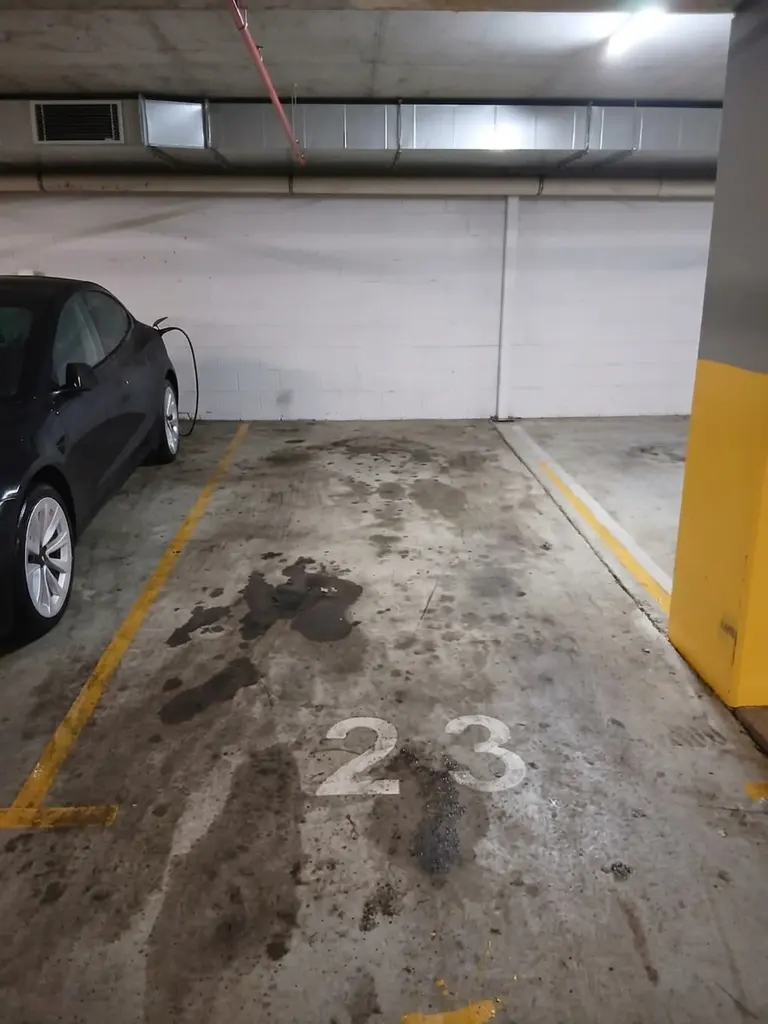
- Oil and grease stains on loading bay and car park concreteHydrocarbon staining responds to pre-treatment and degreasing ahead of the main clean, then targeted pressure cleaning on the affected concrete — treated as its own step, not folded into a general wash.
- Bore-water iron staining on brick, limestone and fencingPerth's iron-rich groundwater leaves rust-coloured deposits wherever reticulation sprays onto light-coloured surfaces. We treat and rinse the staining back, and we're upfront that it returns while the bore keeps running — repeat treatment, not a one-off fix, is the honest answer.
- Algae, moss and lichen on shaded or south-facing surfacesBiological growth is a soft-washing job, not a high-pressure one — low-pressure application of the correct chemistry lifts the organism rather than just knocking off the visible surface layer.
- Limestone or exposed aggregate damaged by the wrong pressurePorous, soft substrates like limestone abrade and "fur up" under the same pressure that unsealed concrete tolerates easily. We match pressure and nozzle to the surface before we start, not after.
- Graffiti on frontages, fencing and hardstandRemoved with a method matched to the substrate underneath the paint, so the surface isn’t damaged in the process of removing the tag.
- Slippery biofilm on pedestrian paths, ramps and entriesRemoving built-up biofilm restores grip underfoot — a genuine slip-resistance benefit, and one we can flag if you also want it independently assessed.
WHY IT MATTERS
What you get
- Dramatically improved presentationYears of grime, oil staining and algae buildup removed in a single visit — the difference between a tired exterior and a well-maintained facility is visible immediately.
- Reduced slip hazardsAlgae and biofilm on paths, entries and car parks are slip risks. Pressure washing removes them as part of routine maintenance.
- Scheduled or one-offOne-off cleans restore the surface; scheduled programs keep it consistently presentable and reduce the build-up that makes future cleans harder.
- Strata and commercial scaleFrom a single retail tenancy entry to a full strata car park or warehouse yard, we scope the job to your actual footprint.
AT A GLANCE
How we approach different surfaces
| Surface | Typical method | Why |
|---|---|---|
| Unsealed concrete hardstand | Higher-pressure clean, surface cleaner for large flat areas | Dense, unsealed concrete tolerates more pressure than most other surfaces on site |
| Brick / rendered masonry | Reduced pressure, wider fan pattern | Higher pressure risks progressive surface damage to mortar joints and render coatings |
| Limestone / limestone paving | Low pressure only | Highly porous and soft — abrades and "furs up" under direct high pressure |
| Exposed aggregate | Reduced pressure, wide fan | Avoids dislodging stones or eroding the cement matrix that holds them |
| Render / stucco | Low pressure | Pressure is the main damage risk on render, more so than water temperature |
| Colorbond / prepainted steel | Low pressure, detergent-led | Avoids driving water under laps and damaging the coating |
| Roofing (tile, metal, asphalt) | Soft wash — low pressure, chemical-led | High pressure strips granules and surface coatings while leaving moss and lichen root structures intact |
This is our practice guidance, not a published standard — no Australian Standard prescribes cleaning pressure by surface. Concrete hardstand tolerates far more pressure than limestone, render or Colorbond, so using one setting across a whole site is how surfaces get damaged.
HOW IT WORKS
How it works
Quote the surfaces
Describe or photograph the areas to be cleaned. We confirm which surfaces are serviceable and quote per job.
Site preparation
We clear the area of moveable items and protect anything that should not get wet. Any drainage or runoff considerations are managed before starting.
Pressure clean
High-pressure cleaning is applied at the appropriate pressure for each surface — concrete, paving and rendered walls each require different treatment.
Inspect and report
We walk the area with you or your manager after cleaning and note any surface damage that was pre-existing — so you're clear on what cleaning achieved.
IN DETAIL
How we think about the job
Pressure is matched to the surface, not the job
There is no Australian Standard that prescribes a cleaning PSI for any given surface — that comes as a surprise to a lot of site managers who assume "high pressure" is a single setting. Concrete hardstand tolerates far more pressure than limestone, render or Colorbond. Using the same setting across a site is how surfaces get damaged, so pressure and nozzle selection change surface to surface, and we set that up before the machine starts rather than adjusting after something marks.
That also means we’ll tell you plainly if a surface on your site is not a good candidate for pressure cleaning at all, and recommend a soft wash or a different method instead. A result that holds is worth more to you than a quick job that has to be redone or repaired.
Why water volume matters more than pressure on flatwork
On large flat areas — car parks, warehouse floors, loading bays — the tool that actually does the work is a rotary surface cleaner: a shielded, spinning spray bar rather than a single wand jet. Used correctly it cleans flat areas roughly three times faster than a wand, with a consistent standoff distance and none of the uneven "zebra striping" a wand leaves on large concrete.
What most competitor pages don't explain is that flow rate — litres per minute, not pressure — is what actually governs how well a surface cleaner performs. Below a certain flow the spinning bar won't turn fast enough to clean evenly; above it, the bar covers ground faster without needing more pressure. As a practical rule, flat areas are a surface-cleaner job and verticals, edges and detail work are a wand job — a car park gets the surface cleaner across the field and the wand around the edges and kerbs.
Soft washing vs high pressure
Algae, moss, lichen and the black staining they cause are a chemistry problem, not a pressure problem. Soft washing — a low-pressure application of a diluted cleaning solution that is left to work before rinsing — kills the organism at the root rather than just knocking the visible growth off the surface. It is the accepted method for roofs in particular: high-pressure washing a tiled or metal roof strips protective granules and surface coatings while leaving the moss and lichen root structures intact, so the growth is back sooner and the roof is worse off than before it was cleaned.
We use soft washing for biological growth on shaded paths, fences, render and roofing, and reserve higher pressure for hardstand, concrete and other surfaces that can genuinely take it. We won’t promise a growth-free result for a set number of years — that depends on shade, moisture and the surface itself, not on the cleaning method, and we’d rather be accurate about that than make a claim we can’t back up.
STANDARDS & COMPLIANCE
Standards, water rules and compliance
Water Corporation trade waste requirements
- Who it binds
- The business operating or discharging from a washdown area
- What it requires
- A current Water Corporation trade waste permit is required before any trade wastewater is discharged to sewer, the wastewater must pass through an approved pre-treatment fixture, single/double/triple interceptors are not accepted as final pre-treatment, unroofed washdown areas are capped at 20 square metres, and only quick-breakdown detergents are permitted.
- What we do
- We plan washdown method and water use around these rules on every job — sweeping or vacuuming loose material first, using quick-breakdown detergents, and avoiding uncontrolled discharge to drains.
We do not hold or apply for your site's trade waste permit — that sits with the site owner or operator, not the cleaning contractor.
Environmental Protection Act 1986 (WA)
- Who it binds
- The occupier or business responsible for the site
- What it requires
- It is an offence to discharge contaminated wastewater or liquid waste to stormwater drains in WA. Stormwater and wastewater must be kept entirely separate, and DWER (Department of Water and Environmental Regulation) enforces pollution control, with local councils as the first point of report.
- What we do
- We don't hose surfaces where dirty water would reach a stormwater drain uncontrolled — where that risk exists, we sweep or vacuum loose material first, or contain and manage the runoff rather than let it run to the gutter.
We do not treat, transport or dispose of contaminated wastewater — that requires a DWER controlled waste carrier licence, which we do not hold.
WHS Act 2020 (WA), WHS (General) Regulations 2022 (WA) and AS/NZS 4233.1:2013 (high-pressure water jetting)
- Who it binds
- The PCBU carrying out the work, and the PCBU controlling the site
- What it requires
- High-pressure water jetting is a recognised hazard under WA WHS law, with AS/NZS 4233.1 setting out the risk framework for high-pressure water jetting systems — covering hose whip restraints, correctly rated fittings, and training by a competent person.
- What we do
- This is the risk framework we work within on every job — equipment checks, hose restraint and operator awareness of the injury risk from high-pressure jets.
AS 4586 and AS 4663 — pedestrian surface slip resistance
- Who it binds
- The building owner or facility manager responsible for the surface
- What it requires
- AS 4586 classifies the slip resistance of new pedestrian surface materials. AS 4663 is the separate standard for measuring slip resistance of existing, in-service surfaces, and was developed specifically to monitor changes in slip resistance caused by cleaning and maintenance activity.
- What we do
- Removing built-up biofilm generally restores grip underfoot, which is a genuine safety benefit of routine cleaning. If your car park or walkway is part of a formal slip-risk register, we can flag that AS 4663 testing exists as the correct way to have it independently assessed.
We do not perform AS 4663 slip-resistance testing ourselves.
Standards information current as at July 2026.
HOW THIS IS PRICED
How pressure cleaning is priced
- Total area to be cleaned and the mix of surfaces on site
- Substrate type — concrete, limestone, render, Colorbond, roofing
- Type and severity of soiling (general dirt vs oil, algae or iron staining)
- Site access and whether equipment can reach all areas
- Availability of water and power on site
- Whether the job needs to run after hours or around live operations
- Waste-water capture and disposal requirements for the site
Price on application — request a quote for a clear, fixed price after a site walkthrough.
WHY GENRE
Why Genre Solutions
- Oil and grime treatmentLoading bays and car parks with heavy oil contamination receive pre-treatment before pressure washing for a result that holds longer.
- Honest about surfacesWe confirm which surfaces are safely serviceable before quoting. We will not pressure-wash surfaces likely to be damaged — results are only as good as the surface allows.
- Paired with end-of-lease and builders cleansPressure washing pairs naturally with vacate cleans and construction handovers. Bundle both for a single booking and have everything done at once.
Related services
- Industrial & Warehouse CleaningWarehouse floors, racking and loading docks — the inside complement to hardstand and exterior pressure cleaning.
- Strata & Common Area CleaningCar parks, driveways and common grounds cleaned as part of a scheduled strata maintenance program.
- Construction & Builders CleaningPair a hardstand and frontage pressure clean with a final builders clean ahead of handover.
- Mining Machine CleaningHigh-pressure cleaning of heavy plant, machinery and yards for resources and transport operators.
Before & After
- Before
 After
After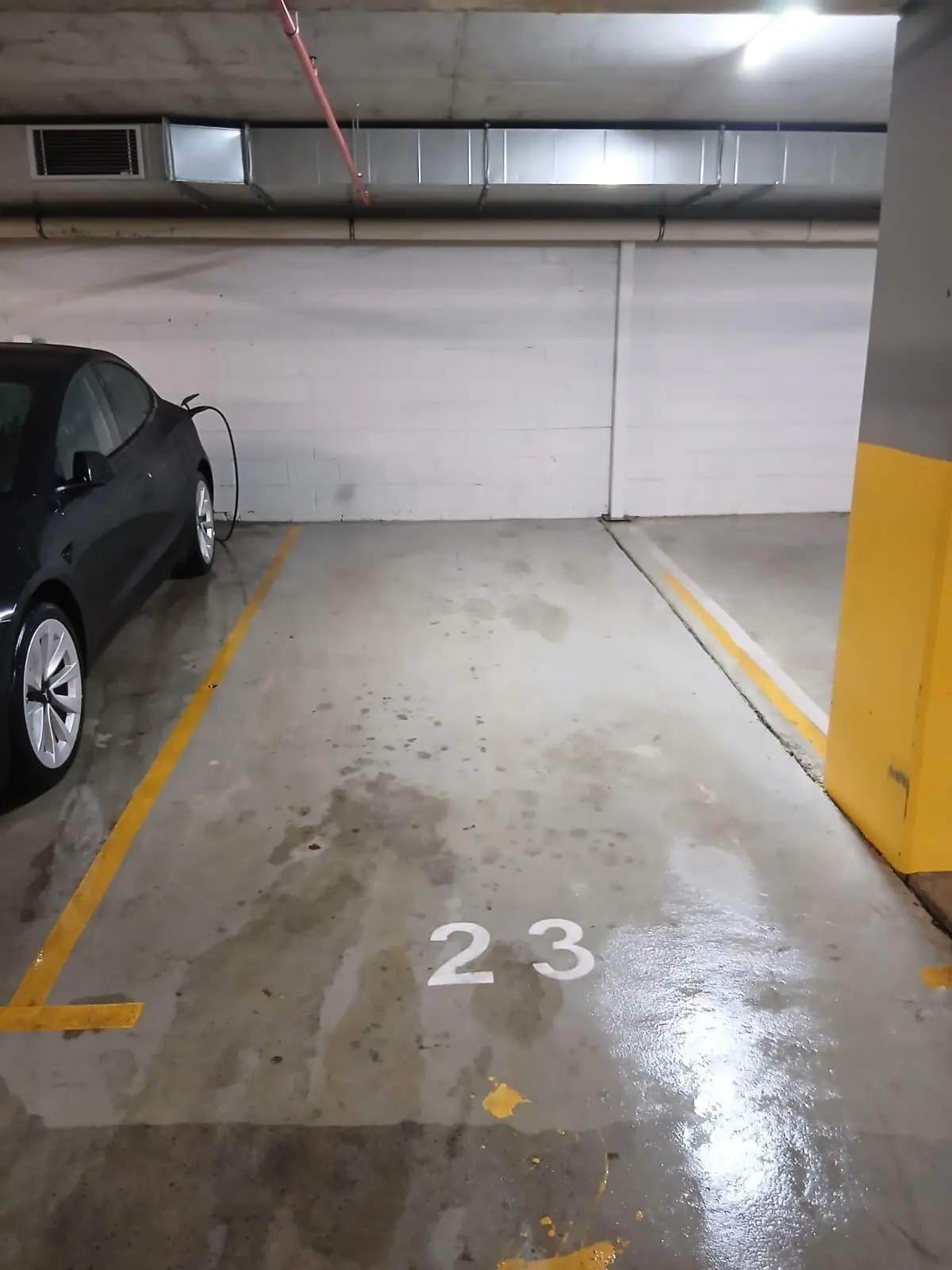
Car park bay pressure clean
- Before
 After
After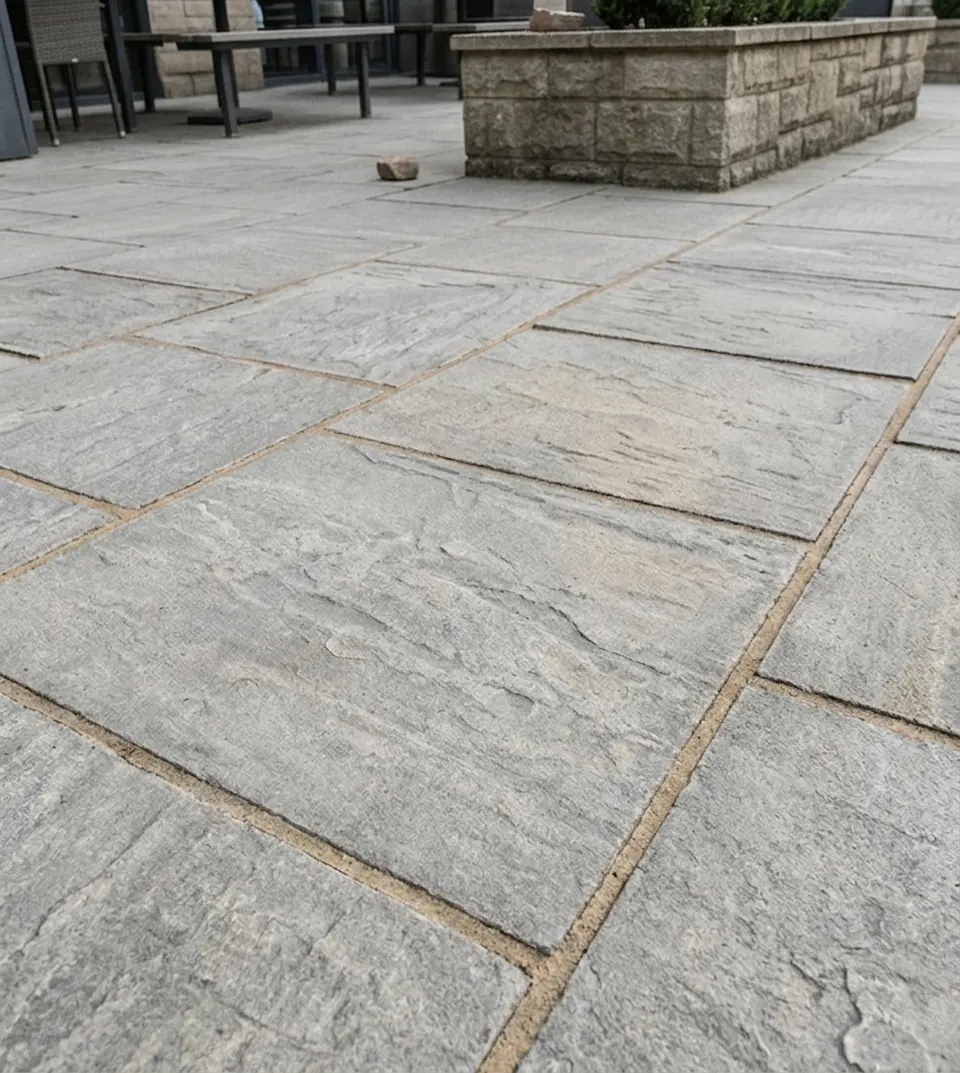
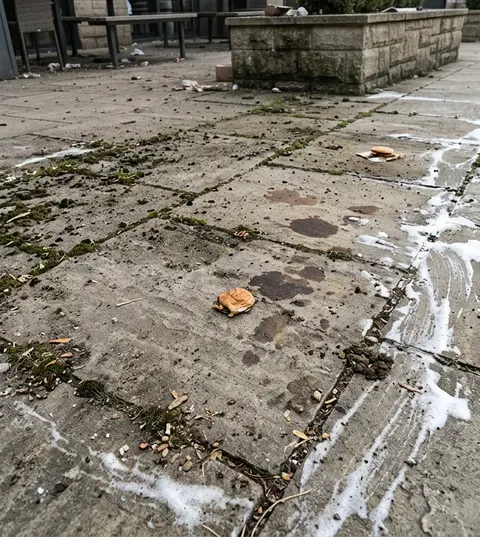
Outdoor tile pressure clean
Insured & police-checked
- WA owned & operated
- $20M public liability insured
- Police-checked crews
- WHS & safety-first
- Perth-based, locally operated
- After-hours available
Pressure cleaning FAQ
Will high-pressure cleaning damage limestone, exposed aggregate or render?
What's the difference between pressure cleaning and soft washing?
Can you remove bore-water iron staining permanently?
Do you use hot water? Do I need it?
Where does the dirty water go — is it legal to wash it into the drain?
Are we allowed to pressure clean under Perth's water restrictions?
How often should a commercial car park or hardstand be cleaned?
What's the best time of year to have exterior surfaces cleaned in Perth?
Do you remove oil and grease stains, or just general dirt?
Can you work after hours so we don’t need to close the car park or loading bay?
Will pressure cleaning make a surface more slippery?
Do we need to supply water and power on site?
Request a quote
Price on application — request a quote or a free site walkthrough and we'll give you a clear, fixed price.