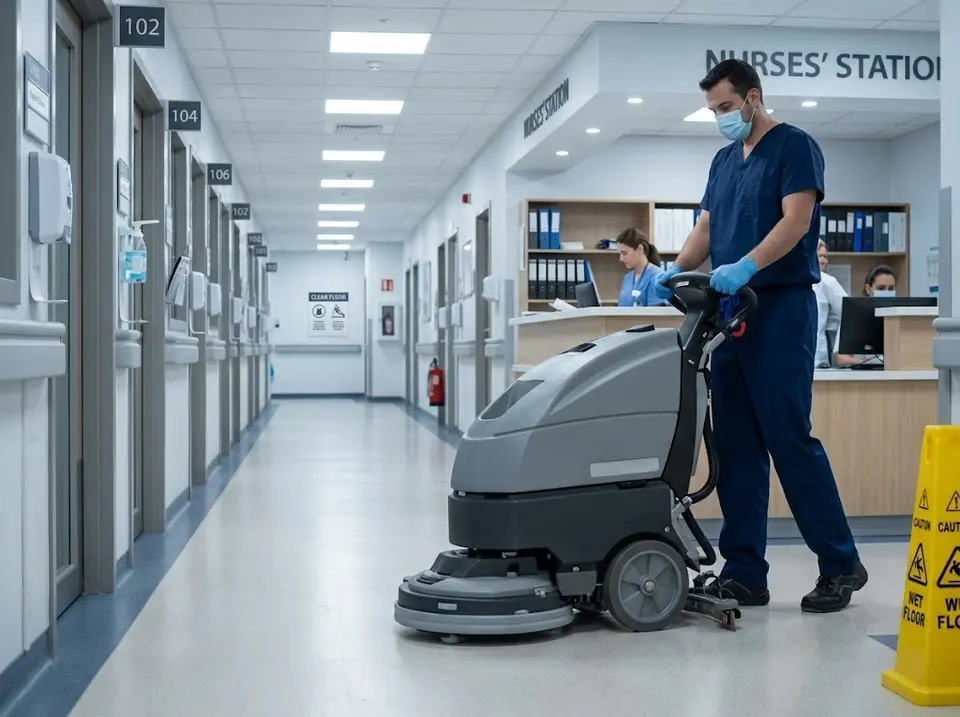
Healthcare & Medical Facility Cleaning
Medical Centre & Healthcare Cleaning in Perth
Careful, detail-driven cleaning for medical practices, allied health rooms and clinical environments, with a focus on high-touch areas and cross-contamination control.
- $20M public liability insured
- Police-checked crews
- WA owned & operated
OVERVIEW
Who it's for
Genre Solutions cleans GP practices, allied health rooms, specialist consulting suites and day-clinic environments across Perth, including the medical precincts around Murdoch, Nedlands, Subiaco, Perth CBD, West Perth, Joondalup and Midland. Most of the practices we work with are general practices, physiotherapy rooms, dental and allied health clinics rather than hospitals — a distinction that matters, because the standards that actually apply differ from what most healthcare-cleaning marketing implies.
General practices in particular are not assessed under the National Safety and Quality Health Service (NSQHS) Standards. GP practices accredit against the RACGP Standards for general practices, 5th edition. Hospitals, day procedure services and some public health settings sit under NSQHS Standard 3, Action 3.13 — Environmental Cleaning. Getting this distinction right at the start of a relationship, rather than talking about 'hospital-grade' this and 'NSQHS compliant' that regardless of what kind of practice we're actually cleaning, is the difference between accurate marketing and a claim that quietly falls apart the first time a practice manager checks it.
We are a general commercial cleaning contractor. We do not hold NSQHS accreditation — no such accreditation exists for a vendor, only for the health service organisation itself. We do not reprocess reusable medical devices, and we are not a licensed clinical-waste carrier. What we can genuinely offer is a documented, detergent-first cleaning method, a risk-zoned schedule built with your infection-control lead, and the records — signed schedules, task logs, training records — that support the evidence your own accreditation process asks for.
GP practices, medical centres, allied health rooms, specialist consulting rooms and day-clinic environments across Perth. Client and environment types referenced only with permission.
WHAT WE DO
What's included
- Waiting rooms, reception and consult rooms
- High-touch-point cleaning and disinfection
- Treatment and procedure room presentation
- Amenities and staff areas
- Colour-coded equipment to reduce cross-contamination
- Waste-stream awareness (general vs clinical handled per site protocol)
Reception & waiting areas
- Reception counter, EFTPOS and sign-in equipment touchpoints
- Waiting room seating, toy areas and reading material surfaces
- Entry glass and signage
Clinical zones
- Consult and treatment room surfaces, benches and light switches
- High-touch equipment surfaces cleaned to your documented protocol
- Terminal cleans on request following discharge, transfer or an infectious case
Amenities & waste
- Washrooms with dedicated colour-coded equipment
- General waste collection and bin area cleaning
- Clinical waste segregation into your compliant containers (collection by your licensed carrier)
Pricing is based on site size and scope. Price on application — request a quote for a clear, fixed price after a site walkthrough.
COMMON PROBLEMS
Common problems we solve
- High-touch surfaces in consult and treatment roomsDoor handles, examination benches, light switches and reusable equipment surfaces are cleaned daily or more often, and immediately after contamination with blood or body fluids — the touch-frequency principle behind every credible environmental cleaning schedule.
- Cross-contamination between clinical and non-clinical zonesColour-coded, single-use-per-zone equipment keeps washroom, clinical and general-office cleaning separated, documented as our own procedure rather than attributed to a national mandate that does not name a specific colour scheme.
- No documented evidence for accreditation assessorsEvery visit produces a record — signed cleaning schedule, task completion, product and dilution used — so your practice has the paper trail an AGPAL, QPA or RACGP assessor asks to see, without you having to build that system yourself.
- "Sanitising" marketing that overstates what routine cleaning doesAustralian infection-control guidance is detergent-first: neutral detergent and water for routine cleaning, with disinfection reserved for extreme-risk areas and outbreak or terminal cleans. We follow that method rather than marketing blanket disinfection we do not need to perform.
- Uncertainty about who may handle clinical wasteWe segregate general and clinical waste into your compliant containers and coordinate collection timing with your licensed clinical-waste carrier — we do not transport clinical waste ourselves, because that requires a licence we do not hold.
- Waiting rooms and reception presenting inconsistentlyHigh-touch counters, EFTPOS terminals, door handles and seating are cleaned to the same daily standard as clinical areas, because the waiting room is the first thing every patient judges the practice on.
AT A GLANCE
A frequency principle by zone
| Zone | Frequency principle | Basis |
|---|---|---|
| Treatment / consult rooms | Frequently touched surfaces and patient equipment cleaned daily or more often, and immediately after blood or body-fluid contamination | Touch-frequency and risk-based principle |
| Waiting room / reception | High-touch points (counters, EFTPOS, door handles, toy or magazine areas) cleaned daily or more; floors daily | Touch-frequency principle |
| Washrooms | Daily minimum, more often in high-throughput practices, with dedicated colour-coded equipment | Convention |
| Minimally touched surfaces (floors, walls, ceilings, admin areas) | Daily or less frequently, per an agreed schedule | Risk-based principle |
| Terminal clean | On patient discharge or transfer, or after an infectious or multi-drug-resistant organism case: all surfaces including those outside the routine schedule, plus disinfection | Infection-control convention |
| Clinical waste areas | Segregated per collection cycle — no transport without a DWER controlled waste carrier licence | WA controlled waste regulation |
Set with your infection-control lead, not imposed. This is a frequency principle drawn from general Australian infection-control guidance, not a schedule mandated for every practice — the actual schedule is agreed at the site walkthrough.
HOW IT WORKS
How it works
Site walkthrough & protocol review
We visit your practice, walk through clinical, non-clinical and amenity zones, and confirm what products, sequencing and access arrangements the site already requires.
Risk-zoned scope and schedule
We agree the zones, frequencies and method with your infection-control lead or practice manager — waiting room, consult rooms, treatment areas, washrooms and clinical waste handling.
Detergent-first, documented delivery
The same crew follows the documented method at every visit — neutral detergent and water for routine cleaning, manufacturer contact time observed wherever disinfection is used — with a signed record produced each visit.
Direct communication with the owner
Any protocol change, access issue or concern goes straight to the owner — no subcontract chain and no call centre between you and the person who can actually change something.
IN DETAIL
How we think about healthcare cleaning
Detergent first, disinfection when it is actually needed
Australian infection-control guidance for healthcare environments is explicit: use neutral detergent and water for routine cleaning. Disinfectants are reserved for extreme-risk areas, outbreak management and terminal cleaning following an infectious or multi-drug-resistant organism case — not applied as a matter of routine to every surface on every visit. That runs against a lot of cleaning marketing, which leans on 'sanitising everything' as if more disinfectant automatically means a cleaner practice.
There is a practical reason detergent-first matters, not just a regulatory one: disinfectants are inactivated by organic soil, so a surface has to be physically cleaned before disinfection can do anything useful — you cannot disinfect a dirty surface and expect the product to work as labelled. Where disinfection is used, the manufacturer's stated contact or dwell time has to be observed for it to be effective at all, which is a detail routinely skipped when a job is rushed.
We work to this two-step method — clean, then disinfect only where the risk level actually calls for it — because it is both the accurate Australian guidance and, frankly, the more defensible position for a practice that gets asked to justify its cleaning regime at accreditation time.
What NSQHS Action 3.13 actually asks for — and who it applies to
NSQHS Standard 3 covers preventing and controlling infections, and its environmental cleaning requirement sits specifically at Action 3.13 — not the neighbouring actions on workforce screening or immunisation, which are a different part of the same Standard. Action 3.13 asks a health service organisation to maintain a clean, safe and hygienic environment in line with national infection-control guidance: cleaning and disinfection using products listed on the Australian Register of Therapeutic Goods, staff training on cleaning processes, and audits of cleaning effectiveness feeding back into practice.
NSQHS accreditation belongs to the health service organisation being assessed — there is no equivalent accreditation, certification or approval available to a cleaning contractor, and no vendor can honestly claim to be "NSQHS accredited" or "NSQHS compliant" as a company. What a contractor can genuinely do is deliver the cleaning records, product information and training evidence that make Action 3.13 easier for the organisation to demonstrate at its own assessment.
It's also worth being precise about who this applies to. NSQHS assessments cover hospitals, day procedure services and some public health settings — most GP practices, allied health clinics and specialist rooms are not assessed against NSQHS at all. They accredit against the RACGP Standards for general practices instead. We work with whichever framework actually applies to your practice, rather than defaulting to hospital language because it sounds more impressive.
What "hospital grade" actually means, and why we are careful with it
Disinfectants sold in Australia are labelled hospital grade, commercial grade or household grade depending on the performance testing they have passed, and a product can only be labelled hospital grade if it has actually met that standard — a household or commercial-grade product cannot legally carry the words "hospital grade" on its label or in marketing describing it.
Separately, any claim that a product kills or is active against viruses, spores, tuberculosis, mycobacteria or fungi is treated as a "specific claim" under the therapeutic goods framework, and specific claims require the product to be listed on the Australian Register of Therapeutic Goods. A product that has not been through that listing process cannot honestly carry a virucidal, sporicidal, tuberculocidal or fungicidal claim, however the label reads.
We would rather state our position plainly than overreach: we use products appropriate to the risk level of each area and work to manufacturer instructions and contact times, but we do not describe our general cleaning as clinical-grade disinfection unless the specific product and claim genuinely support it. Where a practice needs a named, ARTG-listed product used and documented for its own accreditation purposes, that is a conversation we have directly rather than a claim we make generically on a marketing page.
STANDARDS & COMPLIANCE
Standards & compliance we work within
Australian Guidelines for the Prevention and Control of Infection in Healthcare (NHMRC, currently maintained edition)
- Who it binds
- The health service organisation, with input from its infection-control lead
- What it requires
- Routine cleaning uses neutral detergent and water; disinfection is reserved for extreme-risk areas, outbreak management and terminal cleaning, with manufacturer contact time observed.
- What we do
- We follow this detergent-first, risk-triggered method as our default, and disinfect only where the risk level or your protocol calls for it.
AS 3816:2018 — Management of clinical and related wastes
- Who it binds
- The practice generating the clinical waste, and its licensed clinical-waste carrier
- What it requires
- Clinical waste must be identified, segregated and stored using compliant containers, and the practice must ensure any contracted carrier holds a valid controlled waste carrier licence.
- What we do
- We segregate clinical waste into your compliant containers in line with your practice policy, and coordinate collection timing with your licensed clinical-waste carrier.
We do not transport clinical waste on a WA road — clinical waste is a controlled waste in WA, and transporting it requires a DWER controlled waste carrier licence, which we do not hold.
Standards information current as at July 2026.
HOW THIS IS PRICED
How this is priced
- Number and type of clinical zones (consult rooms, treatment rooms, procedure areas)
- Practice type — general practice, allied health, specialist or day-clinic
- Frequency and whether terminal cleans are required on an ad-hoc basis
- After-hours or between-session access requirements
- Documentation and reporting requirements for your own accreditation process
- Clinical waste segregation volume and container arrangements
Price on application — request a quote for a clear, fixed price after a site walkthrough.
WHY GENRE
Why Genre Solutions
- Detergent-first, risk-triggered methodWe clean to the detergent-first, disinfect-when-needed method that Australian infection-control guidance actually describes, rather than marketing blanket "sanitising" that overstates what routine cleaning does.
- Accurate about what we are and are notWe are a specialist environmental cleaning contractor, not a reprocessing service or a clinical-waste carrier. We say so plainly, and we do not claim accreditation that does not exist for a vendor.
- Documentation that supports your accreditationSigned schedules, task records and training documentation — built to make your own accreditation evidence easier to assemble, not an extra we charge for separately.
Related services
- Office CleaningFor the administrative and back-office areas of a medical or allied health practice.
- Childcare & Aged Care CleaningSensitive-environment cleaning for the aged care and childcare sectors, using the same risk-based principles.
- Carpet CleaningPeriodic deep cleaning for waiting rooms and consulting suites.
Insured & police-checked
- WA owned & operated
- $20M public liability insured
- Police-checked crews
- WHS & safety-first
- Perth-based, locally operated
- After-hours available
Healthcare cleaning FAQ
Do you clean to RACGP or NSQHS infection control standards?
What's included in a standard medical centre clean?
Do you use hospital-grade, TGA-listed disinfectants?
How do you prevent cross-contamination between clinical and non-clinical areas?
What is a colour-coded cleaning system?
Are your cleaners trained in infection control?
Do your cleaners have National Police Clearances?
Do you handle clinical waste or sharps?
Can you help us prepare for AGPAL or QPA accreditation?
Do you provide documented cleaning schedules and sign-off sheets for our audit evidence?
What's your process for a blood or body fluid spill?
Do you clean treatment rooms differently from waiting rooms?
Request a quote or site walkthrough
Price on application — request a quote or a free site walkthrough and we'll give you a clear, fixed price.