Childcare & Aged Care Cleaning
Childcare & Aged Care Cleaning in Perth
Sensitive-environment cleaning for childcare and aged care settings, with safe products and an infection-control mindset.
- $20M public liability insured
- Police-checked crews
- WA owned & operated
OVERVIEW
Who it's for
Childcare and aged care are two different regulatory worlds sharing one underlying idea: the cleanliness of the environment is a legal duty on the approved provider, not a discretionary extra, and it cannot be handed off to a contractor to hold. What a contractor can genuinely do is deliver the cleaning method and frequency the provider needs, and produce the records that support the provider discharging its own obligation.
For childcare, that duty sits with the approved provider under the Education and Care Services National Law and National Regulations, applied in Western Australia under the Education and Care Services National Law Application Act 2026 (WA) — current from 1 May 2026, replacing the previous WA applied-law arrangement. For aged care, the relevant framework is the strengthened Aged Care Quality Standards, which took effect nationally on 1 November 2025 alongside the Aged Care Act 2024, replacing the previous eight Standards entirely.
We service centres and facilities across Perth's growth corridors — Joondalup, Canning Vale, Cockburn, Rockingham, Baldivis, Ellenbrook, Midland, Bayswater and Victoria Park — as well as established areas including Subiaco, Claremont, Nedlands, Booragoon and Fremantle. Every crew member working in a childcare or aged care environment is police-checked, and we confirm any additional screening a specific site requires before work begins.
Long day care and early learning centres, kindergartens, out-of-school-hours care, residential aged care providers and retirement villages across Perth.
WHAT WE DO
What's included
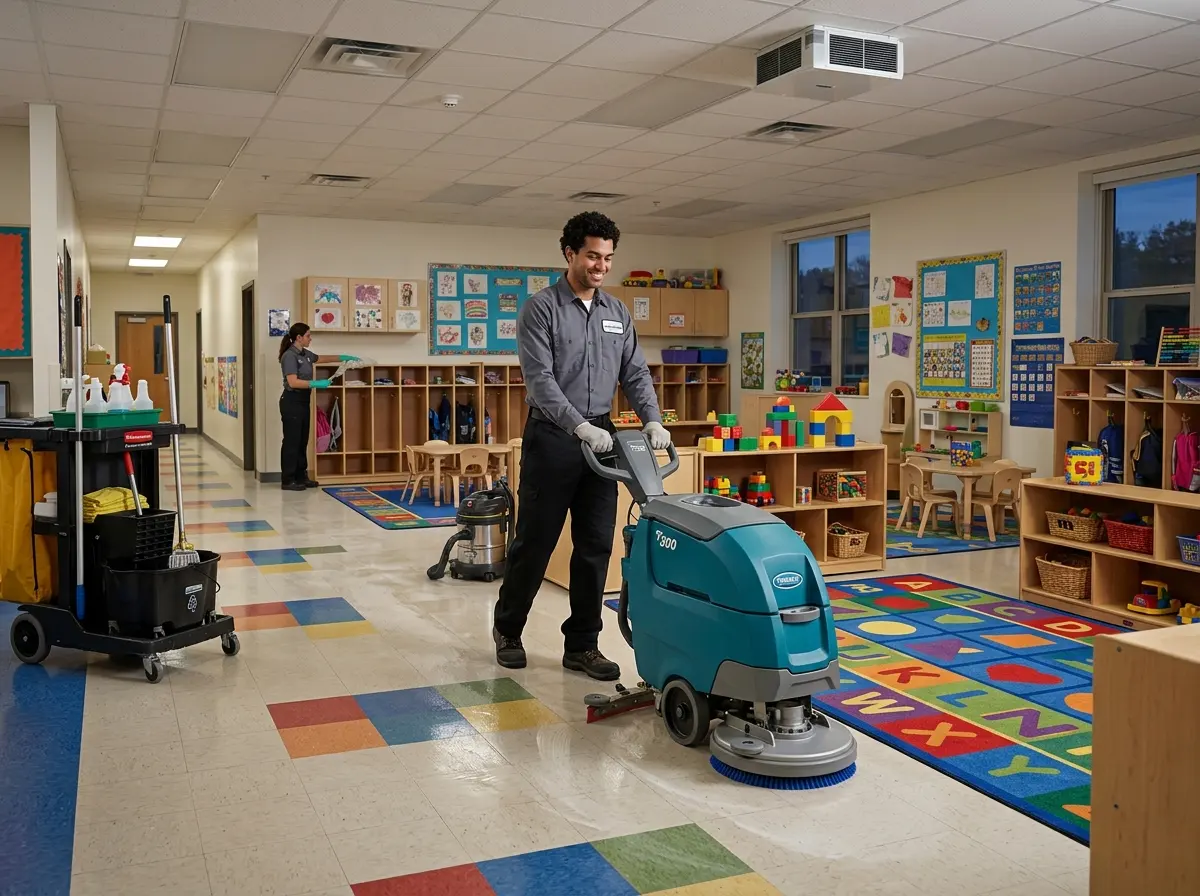
- Playrooms, classrooms and resident areas
- High-touch-point disinfection
- Amenities and bathrooms
- Kitchens and dining areas
- Safe, appropriate product selection
- Police-checked crews
Childcare zones
- Bathrooms, nappy-change areas and toilet facilities
- Toy washing and rotation, including mouthed-toy handling
- Shared beds, linen and rest areas
- Frequently touched surfaces and doorknobs
Aged care zones
- Resident rooms and personal spaces
- Communal, dining and activity areas
- Bathrooms and ensuites with dedicated colour-coded equipment
- Enhanced cleaning under the facility's infection-control direction during a declared outbreak
Pricing is based on site size and scope. Price on application — request a quote for a clear, fixed price after a site walkthrough.
COMMON PROBLEMS
Common problems we solve
- Confusion between routine hygiene practice and hospital-style disinfectionNational childcare hygiene guidance is explicit that routine cleaning with detergent and water, followed by rinsing and drying, is the best way to remove harmful germs from most hard surfaces — we work to that method rather than defaulting to constant disinfectant use.
- Uncertainty over what screening cleaning staff actually holdWe confirm and document the screening appropriate to each environment before any crew member starts, rather than assuming a general police clearance covers every requirement.
- Toys, nappy-change areas and shared surfaces needing different methodsMouthed toys are cleaned daily, all toys washed at the end of every day, and nappy-change surfaces cleaned after every single change — with disinfection added only where body fluids have made contact.
- Cleaning schedules that would not survive an assessment or audit visitWe build the schedule around the frequency table a centre or facility is expected to hold itself to, so the paperwork behind the clean is ready if an assessor or auditor asks for it.
- "Natural" or "chemical-free" cleaning marketing that undersells hygieneNational childcare hygiene guidance specifically advises against using vinegar or bicarbonate of soda as cleaning products because they are not as effective against germs — we use proper detergent-based cleaning rather than a marketing angle that works against the guidance.
- Outbreak periods in aged care needing enhanced, not improvised, cleaningWe increase cleaning frequency and adjust method under the facility's infection-control direction during a declared outbreak — the clinical decision-making stays with the facility, and we deliver the enhanced cleaning it directs.
AT A GLANCE
Frequency, by sector
| Item | Frequency |
|---|---|
| Bathrooms / toilets | Daily and when visibly dirty |
| Frequently touched surfaces, doorknobs | Daily and when visibly dirty |
| Floors | Daily and when visibly dirty |
| Mouthed toys | Daily |
| All toys | Washed at the end of every day, especially in rooms with younger children |
| Shared beds / linen | Daily |
| Low shelves, infrequently touched surfaces | Weekly |
| Nappy change surface | After every change; cleaned then disinfected if body fluids have made contact |
Source: NHMRC 'Staying Healthy: preventing infectious diseases in early childhood education and care services', 6th edition (2024), Table 3.1, p.53. This is a genuinely national, currently-maintained source — not our own scope of work.
| Zone | Frequency principle | Notes |
|---|---|---|
| Resident rooms | Daily, high-touch surfaces more often | Following the same touch-frequency logic used in healthcare settings |
| Communal and dining areas | Daily, with high-touch points cleaned more frequently around meal times | Shared-use areas carry higher touch load |
| Bathrooms / ensuites | Daily minimum | Higher-risk zone, dedicated colour-coded equipment |
| Outbreak-response tier | Enhanced frequency and method, directed by the facility's infection-control lead | Outbreak management is a clinical decision — we deliver the enhanced clean, we do not direct the response |
This zone tier follows the same touch-frequency principle used in healthcare cleaning generally. The actual schedule for a facility is set with its clinical or infection-control lead, not imposed by us.
HOW IT WORKS
How it works
Understand your regulatory environment
We discuss whether your centre or facility sits under the National Quality Framework, the strengthened Aged Care Quality Standards, or another framework, and what that means for scope and documentation.
Confirm screening and access
Police checks and any site-specific screening — including Working with Children Check coverage where relevant — are confirmed before any crew member enters the facility.
Schedule to the guidance, not a guess
For childcare, the schedule follows Staying Healthy Table 3.1 frequencies. For aged care, it follows the touch-frequency and risk-zone logic set with your facility's clinical lead.
Documented, consistent delivery
The same crew follows the agreed method and schedule at every visit, with records kept so the paperwork behind the clean is ready if a regulator or assessor asks for it.
IN DETAIL
Childcare cleaning, done to the actual guidance
Table 3.1 exists — and it directly asks providers to brief their cleaners
The strongest single source for childcare cleaning frequency is the NHMRC's 'Staying Healthy: preventing infectious diseases in early childhood education and care services', now in its 6th edition (2024) — the previous, 5th edition is superseded and shouldn't be cited as current. Its Table 3.1 sets out exactly which surfaces need cleaning daily, which need attention when visibly dirty, and which can be handled weekly, and it is specific about toys, nappy-change surfaces and shared linen in a way most cleaning-company marketing never gets into.
What makes Table 3.1 unusually useful for a contractor relationship is that the guidance directly addresses the situation where a separate organisation cleans the centre: it tells services to tell their cleaning staff about the requirements in Table 3.1. That's a national health guideline explicitly inviting the conversation we already want to have — we would rather walk in already knowing Table 3.1 than have a centre director explain it to us on day one.
The guidance is equally clear on method: routine cleaning with detergent and water, followed by rinsing and drying, is described as the best way to remove harmful germs from hard surfaces, and disinfectant is only used after that cleaning step — never as a substitute for it. Nappy-change surfaces get cleaned after every single change, with disinfection added only where body fluids have actually made contact.
Why we do not market "natural" or "chemical-free" cleaning
A lot of childcare cleaning marketing leans on "natural", "chemical-free" or "non-toxic" language, on the assumption that parents want fewer chemicals around their children. The national guidance actually cuts against that angle directly: it specifically advises against using household products like vinegar or bicarbonate of soda as cleaning products, because they are not as effective against germs as proper detergent-based cleaning.
We take that seriously rather than working around it. We use appropriately diluted detergent-based products suited to a childcare environment, applied with the method the guidance actually describes — spray and rub rather than mist and wipe, fresh detergent solution made up daily and never topped up, cleaning done from the least to the most contaminated areas, and colour-coded cloths kept to their own zone. It is a more defensible position than a marketing claim that quietly contradicts the national guidance it should be aligned with.
Whose duty this actually is — and what a contractor can genuinely add
Under the National Regulations, the approved provider carries the legal duty to ensure premises, furniture and equipment are safe, clean and in good repair — a duty that sits with the provider and cannot be contracted away, whatever the cleaning arrangement looks like. Our role is to deliver the cleaning that duty depends on and to provide the documentation — schedules followed, frequency records, product use — that helps a provider evidence it has been met, not to hold or guarantee the duty itself.
We never claim to guarantee a passing outcome at an assessment and rating visit, because that outcome depends on far more than cleaning. What we can commit to is a documented, Table 3.1-aligned schedule and a consistent crew who already understand why the nappy-change surface, the mouthed toys and the shared linen are treated differently from the low shelves.
STANDARDS & COMPLIANCE
Standards & compliance we work within
Education and Care Services National Law and Regulations, applied in WA under the Education and Care Services National Law Application Act 2026 (WA)
- Who it binds
- The approved provider of the education and care service
- What it requires
- Premises, furniture and equipment must be safe, clean and in good repair, and this duty sits on the approved provider — it cannot be contracted away to a cleaning provider.
- What we do
- We deliver the cleaning method and frequency that supports this duty, following NHMRC Staying Healthy Table 3.1, and provide records that support your own documentation of compliance.
We do not hold the regulatory duty ourselves and do not guarantee a passing outcome at an assessment and rating visit.
NHMRC 'Staying Healthy' guidelines, 6th edition (2024), Table 3.1
- Who it binds
- The approved provider, with guidance directed at both provider and cleaning staff
- What it requires
- Sets specific cleaning frequencies for bathrooms, toys, nappy-change surfaces and shared linen, and directs providers to brief contracted cleaning staff on these requirements.
- What we do
- We schedule cleaning to these frequencies as our default method for childcare sites, and use detergent-first cleaning rather than "natural" alternatives the guidance specifically advises against.
Aged Care Infection Prevention and Control Guide (ACSQHC, August 2024)
- Who it binds
- The facility's infection-control lead
- What it requires
- Outbreak management and enhanced cleaning direction during an outbreak is a clinical decision led by the facility, using a two-step clean-then-disinfect method consistent with national infection-control guidance.
- What we do
- We deliver enhanced cleaning under the facility's infection-control direction during a declared outbreak, using the two-step method it specifies.
We do not run or direct outbreak management ourselves — that is a clinical role, and we deliver cleaning under the facility's direction rather than setting the response.
Standards information current as at July 2026.
HOW THIS IS PRICED
How this is priced
- Number of rooms, resident areas or age-group zones
- Frequency required — daily, or a custom schedule aligned to Table 3.1 or facility policy
- Toy washing, linen handling and nappy-change area load
- Screening and access requirements specific to the site
- After-hours or between-session scheduling needs
- Enhanced-clean or outbreak-response availability, where required
Price on application — request a quote for a clear, fixed price after a site walkthrough.
WHY GENRE
Why Genre Solutions
- Cleaning to the actual guidance, not marketing shortcutsWe schedule childcare cleaning to NHMRC Staying Healthy Table 3.1, and aged care cleaning to the current strengthened Aged Care Quality Standards — not the superseded frameworks a lot of competitor pages still cite.
- We are precise about whose duty this isThe regulatory duty to keep premises clean sits with your organisation and cannot be contracted away. We support that duty with documented cleaning and records — we do not claim to hold or guarantee it.
- Screening confirmed per site, not assumedWe confirm the screening a specific childcare or aged care site actually requires before any crew member starts, rather than a blanket claim about coverage across every staff member.
Related services
- Healthcare & Medical Facility CleaningThe same risk-based, detergent-first method applied to medical practices and clinics.
- NDIS Support CleaningHousehold and support cleaning for NDIS participants under self-managed and plan-managed arrangements.
- Office CleaningFor the administrative areas of a centre or facility alongside its care environments.
Insured & police-checked
- WA owned & operated
- $20M public liability insured
- Police-checked crews
- WHS & safety-first
- Perth-based, locally operated
- After-hours available
Childcare & aged care FAQ
How often should a childcare centre be cleaned?
Do your cleaners have Working with Children Checks?
What cleaning products do you use around children?
Do you clean and sanitise toys and soft furnishings?
How do you clean nappy change areas?
Can you clean after hours?
Will your cleaning schedule stand up at an assessment and rating visit?
Do you understand the Aged Care Quality Standards?
Are your cleaners police cleared and NDIS worker screened?
How do you handle a gastro or respiratory outbreak?
Do you clean resident rooms as well as communal areas?
Are your cleaners trained to work respectfully around residents with dementia?
Request a quote
Price on application — request a quote or a free site walkthrough and we'll give you a clear, fixed price.